Autumn is the time to gather ideas for winter creativity

“The landscape belongs to the person who looks at it.” ~ Ralph Waldo Emerson
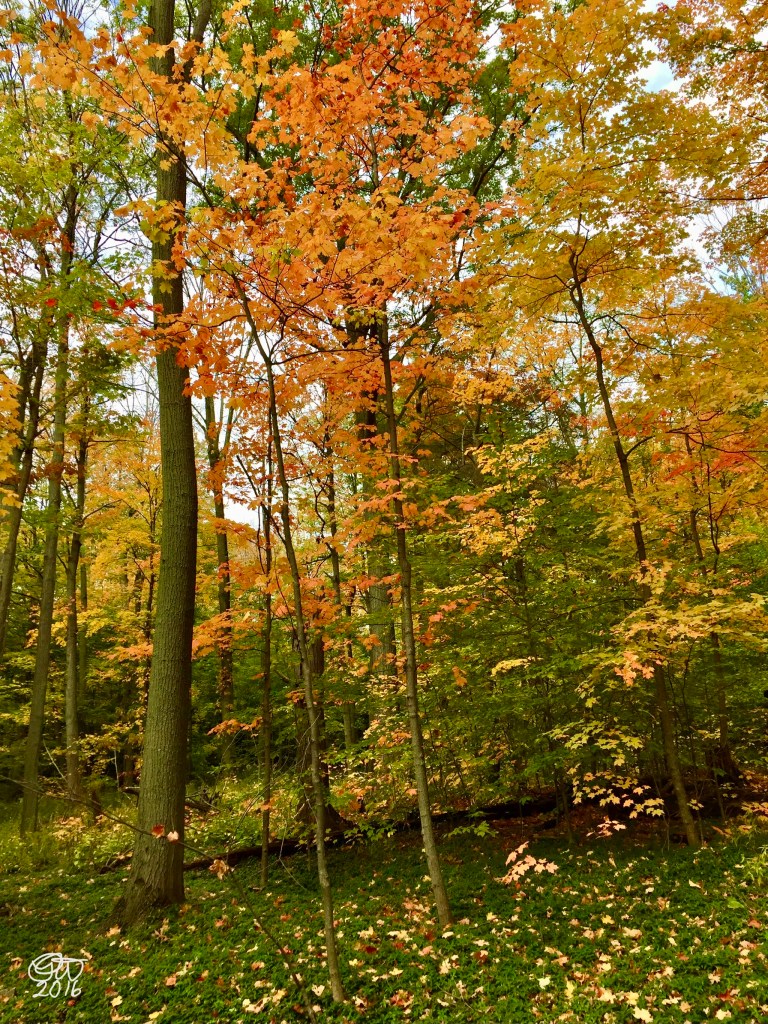
In countries like Canada, the winter can be an inhospitable environment for plein air artists and writers who take inspiration from nature.

Whether you hike on a forest trail, walk to the local park or snap pics of colour in your own backyard, now is the time to collect images to use through the winter as inspiration for making art.

You may choose to take your paints on your hike and create colour studies en plein air (en plein air is a French expression that means in the open air or outdoors, to describe the act of painting outside on location.)

Images can be colour corrected on your computer or tablet and reflected on to a large tv screen, as inspiration, on days when the icy winds are blowing in January. Writers can also find that images work as inspiration for writing a verse or describing a scene.

How do you like to work during the long, cold winter months? Do you brave the temperatures and go out on location, perhaps finding a sunny spot out of the wind, or do you prefer to work with photographs or rough sketches captured in your travelling sketchbook? Or both? Do you have an unusual process that others might try? Please leave a comment. Thank you for reading.

All artwork and creative writing is Copyright © of Patricia White. No use of this content or concept may be used without the express permission of the artist/author.
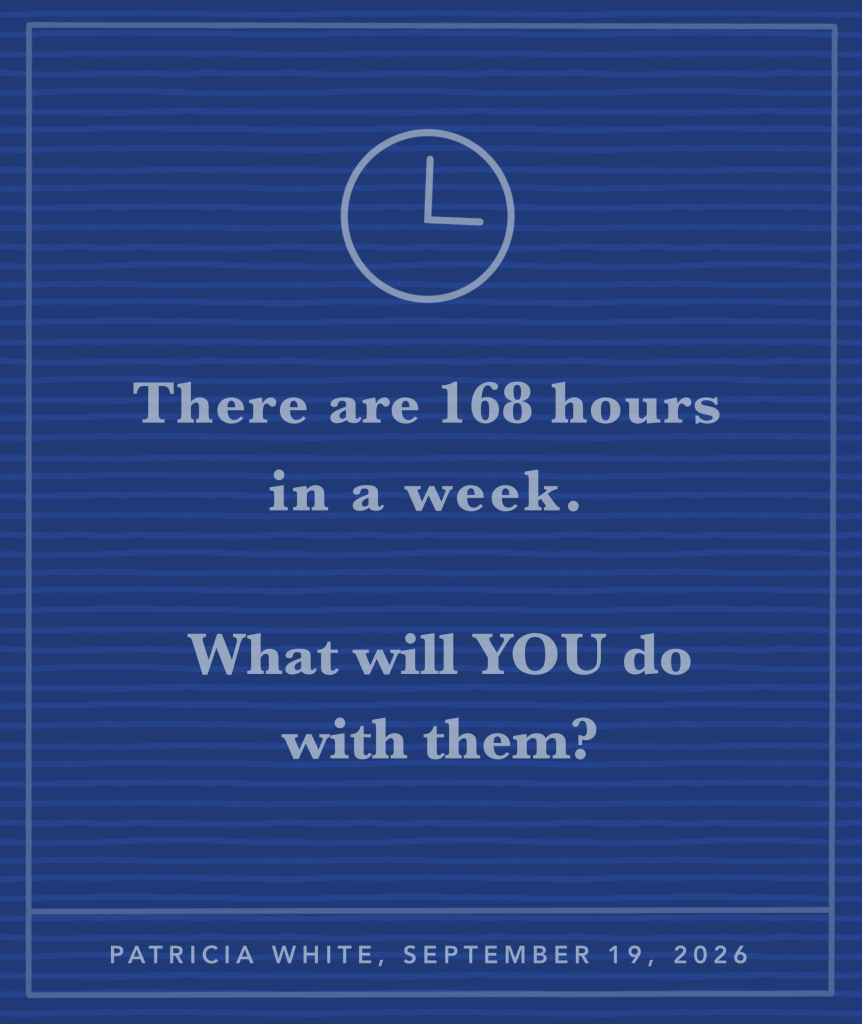
What will YOU do with YOUR 168 hours?

“All we have to decide is what to do with the time that is given to us.” ~ J.R.R. Tolkien

What if one week, 168 hours, was all that was left of your life. What would you do differently than you are doing now? Are there amends you would make with estranged family or friends?

Would you spend it hiking a well-worn trail through an old-growth forest? Compose an opus for the generations, paint a masterpiece or write a biography of your life and times? Would you teach a language or craft to underprivileged youth, or perhaps volunteer to work in a food bank?

Much has been written about the impermanence of life. Love ballads, songs of sorrow for missing times and people. Grand epics, from The Lord of the Rings to Asimov’s Robot series; Shakespeare’s Othello to Tchaikovsky’s Swan Lake.

The saying “youth is wasted on the young” may be true in the respect that we have no foreknowledge of the impermanence of life when we are becoming who we are, whether it is who we are ‘meant’ to be or who we become as a consequence of our life experiences.

Jot your thoughts in the comments. Thanks for reading.


All artwork and creative writing is Copyright © of Patricia White. No use of this content or concept may be used without the express permission of the artist/author.


How Do You Define Creativity?

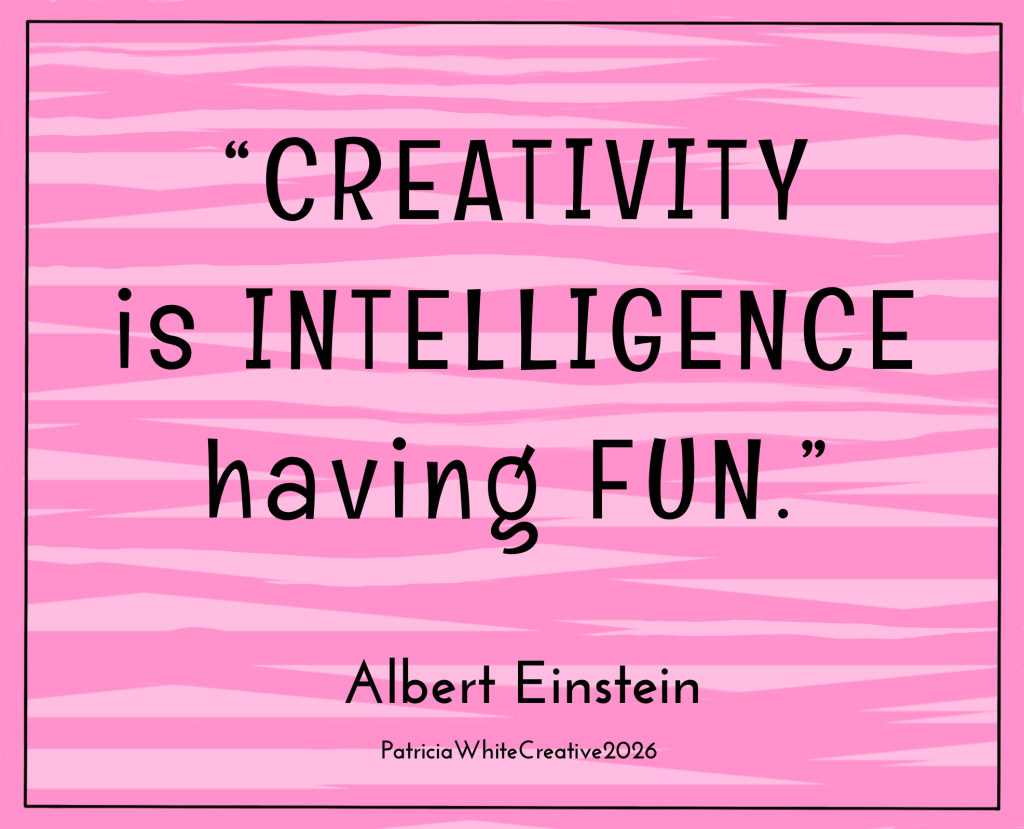
“Creativity is intelligence having fun. ~ a quote from Albert Einstein”

How do you define creativity? Most people likely think of ‘creativity’ as artistic. Painters, musicians, actors, writers — all use creative methods.

The Cambridge Dictionary defines it as “the ability to use imagination to produce original ideas, objects or solutions to problems.”

Creativity might be an idea for a new product, application or process. A solution to a problem. A unique process. Devices such as the phones and tablets most of us use today instead of bulky computers. New ways to help clean the earth’s air and water pollution. Limit sickness.

I would argue that the home cook who experiments with herbs and spices to enhance the taste of the food she serves to her family is being creative. The gardener who employs his hedge clippers to create a giant rabbit or a sailing ship topiary from the yew bush in his yard. The new mother who knits booties for her newborn child. The aging senior who prepares a memory book for the generations that come after. All are using creative methods.

What other creative examples can you think of? Add them to the comments section. Thank you for reading. ❤️

All artwork and creative writing is Copyright © of Patricia White. No use of this content or concept may be used without the express permission of the artist/author.

Modern Technology: A Not So New Paradigm for Creating Art

“It’s not what you look at that matters, it’s what you see.” ~ Henry David Thoreau

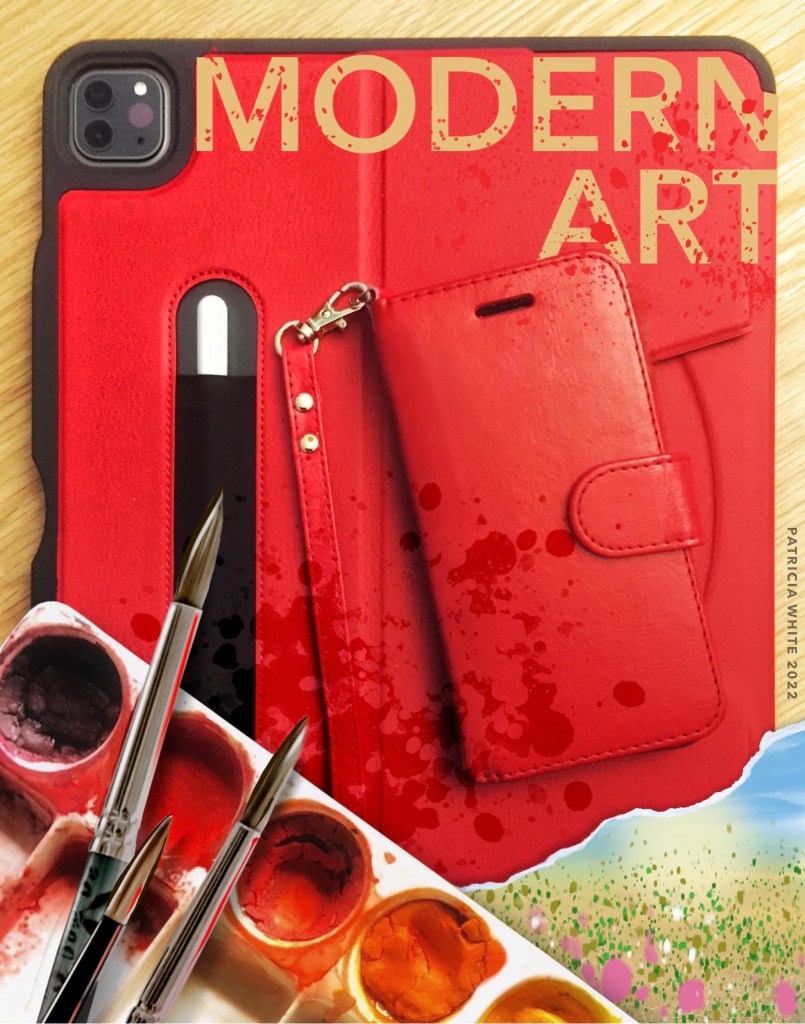
Modern Art 2022

I resisted creating digital art for a long time. I was wrestling with whether it was ‘real’ art if actual materials were not used. For example: paint (acrylic, gouache, watercolour), pastels (soft and oil), graphite, coloured pencils, as well as other materials.

Although I still mostly work in analogue art (click links to see a couple examples: link, link, link), as arthritis worsens in my hands and arms, I might work digitally. At times creating concepts to be reproduced later with brush, paint and other materials.

I created this 2022 screenshot of some of the devices I utilized (iMac not pictured) to try out concepts as well as to create fully digital works. Note: a flat-bed scanner is also a useful tool for incorporating analogue work.

Procreate is one of the applications I find most useful, along with Adobe Fresco and, for a time, the Affinity Suite of apps, though I have not used them since they added ai (artificial intelligence). Call me old-fashioned but I want my art to be my work and mine alone, not taken from other artists without their permission. I ran a design agency for many years and we took copyright issues seriously. Nothing has changed in my attitude to using work that is someone else’s, without payment and/or attribution.

Thanks for reading.
How do you like to work with new tools?

Leave a message in the comments.

All artwork and creative writing is Copyright © of Patricia White. No use of this content or concept may be used without the express permission of the artist/author.

Inspiration: Where To Find It When You Need It

“You can’t wait for inspiration, you have to go after it with a club.” ~ Jack London, Author

Generally, when I get into a creative dry spell, I just keep going, doing something. Anything. A tiny sketch, a collage. A poem, a short story or new character profile for a future work. A found materials creation. I might even work up a new plant-based recipe in the kitchen. Any activity that engages the imagination.

I often pick up art books to help me get out of creative doldrums. I followed the author of this book years ago on Skillshare and YouTube

Check out the 52 Weeks of Creative Living book here.

What do you do to break a creative block? Put your suggestions in the comments.

All artwork and creative writing is Copyright © of Patricia White. No use of this content or concept may be used without the express permission of the artist/author.

Finding Creative inspiration

“Imagination is more important than knowledge.” ~ Albert Einstein

Love this quote from one of my art instructors at the Dundas Valley School of Art (Ontario, Canada) back in the 70s.

Gordon Perrier was not only a renowned painter, but a creative thinker of the first order. I feel fortunate to have had the opportunity to attend his courses.

The expansive way I’ve grown to think about the arts, painting, drawing, plastic arts (mostly hand-built porcelain clay works), creative writing, etc., was influenced, in part, by these early creative experiences.

Where do you find inspiration for your art or creative writing? Leave a message in the comments.

All artwork and creative writing is Copyright ©️ of Patricia White. No use of this content or concept may be used without the express permission of the artist/author.

10 Fascinating Facts About Art from Neuroscience

“I am enough of an artist to draw freely upon my imagination.” ~ Albert Einstein

Great article: exploring art in relationship to the brain.

Did you know that creating or viewing art can rewire your brain? Whether you’re an artist, an art lover, or just curious about the mind, the relationship between art and the brain is fascinating. From boosting memory to enhancing problem-solving skills, art engages our brains in unique and powerful ways.

Art can make you a better problem-solver.

Working with clay will calm you down, more so than drawing with a pencil. Note: I can attest to this having worked in plastic arts for years. Nothing like ‘playing in the mud’.

Empathy shapes how we experience art.

Different kinds of art light up different brain areas.

Creating art can boost memory as we age.

Instruction in art-making may make your brain more relaxed.

Art-making activates reward pathways in the brain.

See story here.

All artwork and creative writing is Copyright ©️ of Patricia White. No use of this content or concept may be used without the express permission of the artist/author.

The Value of Miniature Sketching

“A day is a miniature eternity.” ~ Ralph Waldo Emerson

I try to adhere to a daily practice of creating something—be it a paragraph or two to further a story or verse; a thumbnail sketch, or a quick concept to be used later for a larger work of art. I like the challenge of doing tiny works, making sure they have the same impact and balance as larger pieces.

I found this 2” square seascape in an old sketchbook today. 

I generally list materials used for future reference: In this case, I used Faber-Castell, Grumbacher and Gallery Soft Pastels, plus a few CarbOthello pastel pencils. Created May 24, 2023, 1130am. 


What practices do YOU use to preserve ideas to use for later works?

All artwork and creative writing is Copyright ©️ of Patricia White. No use of this content or concept may be used without the express permission of the artist/author.

Quick sketch of painted Posies in a glass vase

“ I paint flowers so they will not die.” ― Frida Kahlo

This quick sketch, painted in 2022, shows how much movement can be produced in a quick rudimentary study. In this case, I created this concept in Procreate, using oil paint brushes. This process makes it easy to quickly get a concept down which can then inform a later, more detailed, work using analogue materials. It’s quick. It’s better for the environment (fewer caustic materials going into landfill). It’s a great way to test positioning various elements on the page, experimenting with how the elements relate to each other as well as testing various ways to place the elements on the canvas (I’d move the main elements a bit to the right, tho not centred, in the next iteration).


All artwork and creative writing is Copyright ©️ of Patricia White. No use of this content or concept may be used without the express permission of the artist/author.